Enterprise data platform, from concept to commercial use
Meridian: Turning fragmented healthcare data into self service decisions
Converted an analyst dependent workflow into a configurable product that helped commercial and analytics teams move from business question to usable data in 2 to 3 hours instead of approximately 24 hours.
Product name, customer details, and selected data references have been anonymized. Metrics are presented as approximate values.
- Role
- Senior Product Manager
- Timeline
- 2022 to 2025
- Team
- 12 person cross functional pod across product, engineering, data engineering, data science, design, and commercial teams
Business problem
Fragmented data made repeatable questions slow to answer.
Healthcare and commercial data was fragmented across claims, clinical, provider, CRM, and external sources. Repeated questions required analyst support, creating queues that slowed proposal and delivery workflows.
My ownership
Product strategy, roadmap, discovery, prioritization, workflow design, backlog, adoption, vendor evaluation, sales enablement, and go to market readiness.
Shared delivery
Engineering, data science, data operations, design, sales, and subject matter experts partnered on implementation and delivery.
Users and discovery
Meridian served a mixed group of commercial, clinical, analytics, and Medical Affairs users. Teams included Deployment Solutions, Consulting, Digital Outreach, Clinical Site Startup, analytics, and Medical Affairs.
More than 20 power users regularly created cohorts, ran analyses, reviewed outputs, or downloaded data.
Users and decisions
Built around the decisions teams needed to make.
Primary users
- — Commercial strategy teams
- — Analytics teams
- — Proposal teams
- — Field planning teams
Decisions supported
- — Cohort definition
- — HCP and HCO targeting
- — Patient journey analysis
- — Field force planning
- — KOL research
- — Site and population opportunity assessment
Product response
Configurable workflows, with a path for exceptions.
Meridian combined configurable, no code workflows with reusable modules, governed data access, dashboards, maps, and exports. Analysts retained direct access for unsupported or genuinely new questions rather than forcing every request through the product.
01 · Platform architecture
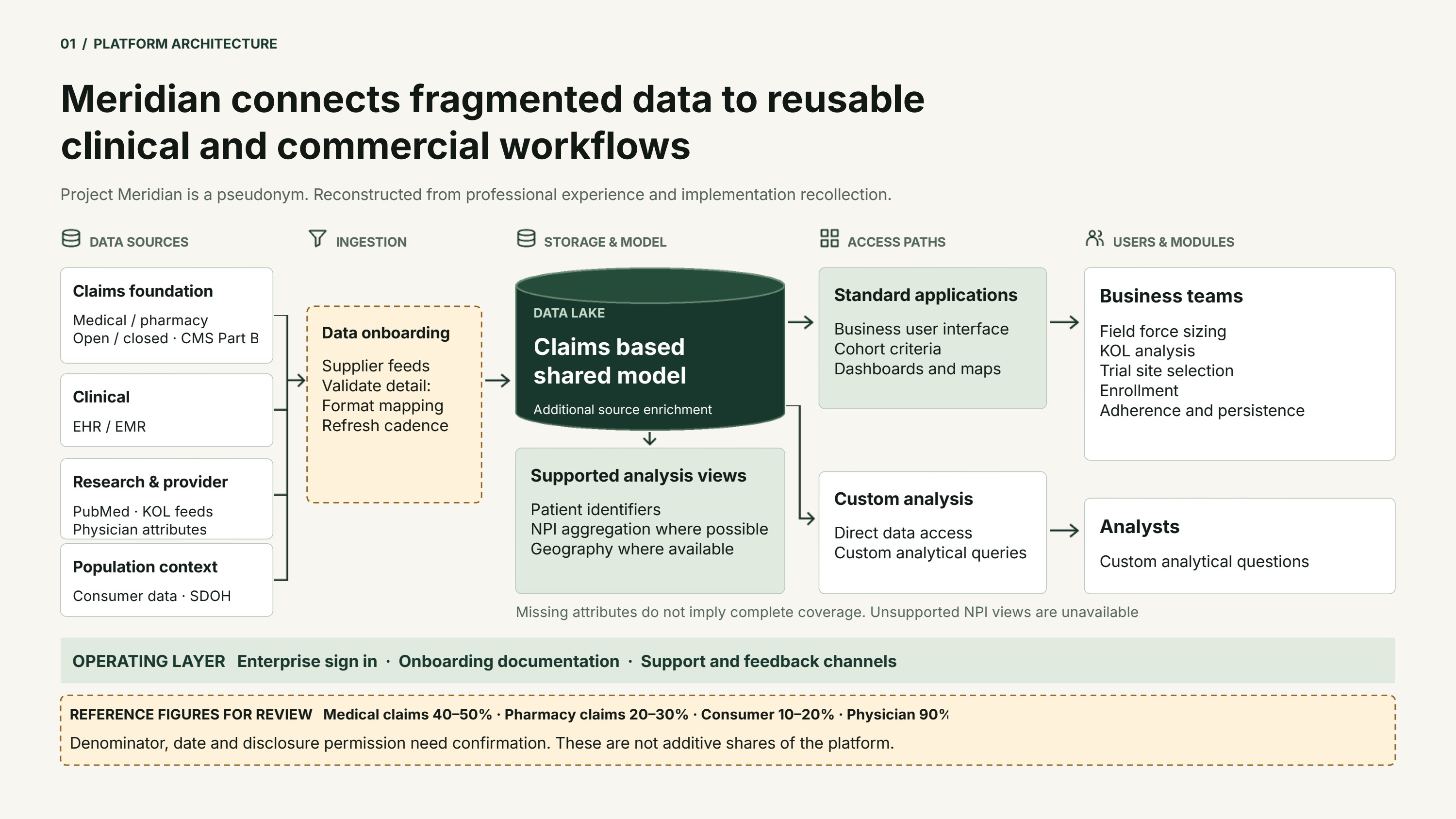
Before and after workflow
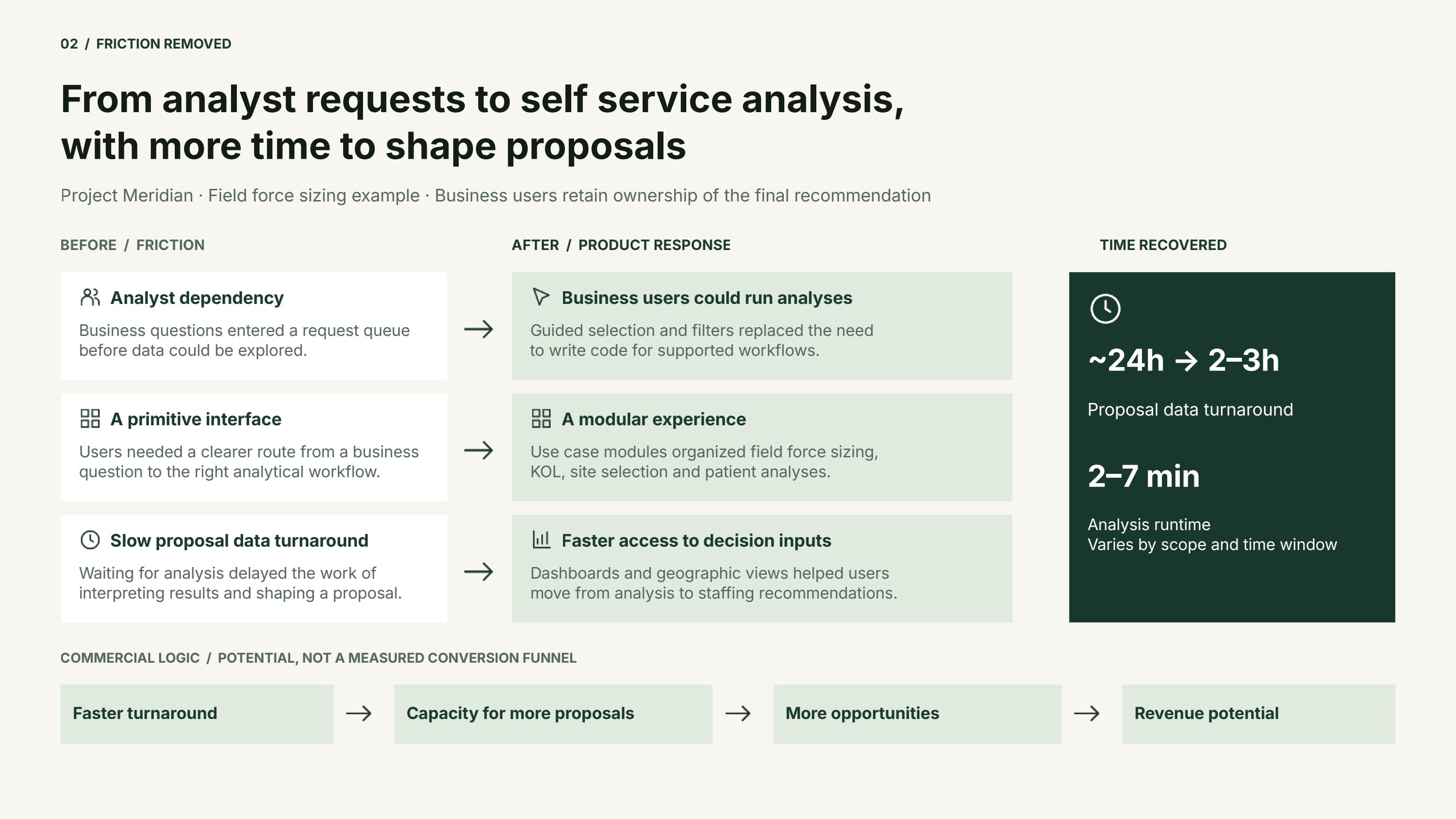
Removed the analyst queue from repeatable work.
Before
Business question → Analyst request → Queue → Manual data preparation → Analysis → Recommendation
After
Business question → Guided configuration → Reusable analysis → Dashboard or export → Recommendation
Turnaround
Approximately 24 hours to 2 to 3 hours
02 · Friction removed
Product prioritization
Prioritization evolved as the product matured.
Prioritization evolved with the product. MoSCoW helped define the MVP. After launch, roadmap decisions combined user demand, commercial value, data readiness, strategic reuse, delivery effort, risk, customer urgency, executive direction, and observed usage.
What users needed after launch
Data accuracy and issue resolution
Repeated support requests identified data defects, validation gaps, calculation issues, and areas where users needed clearer explanations.
New data and product capabilities
Users requested additional data assets, meaningful KPIs, and features supporting new commercial and clinical questions.
Ad hoc data support
Teams needed easier ways to incorporate project specific datasets, manipulate data, and validate it against the shared platform foundation.
Stage one · MVP definition
MoSCoW identified the foundational capabilities required for the initial product.
Must have
- — Claims foundation
- — Secure access
- — Cohort workflow
- — Reusable analysis
- — Data documentation
Should have
- — Geographic visualization
- — HCP and HCO targeting
- — Patient journey modules
- — Export functionality
Could have
- — AI summaries
- — Natural language querying
- — Additional enrichment sources
Will not have yet
- — Unsupported autonomous decisions
- — Features without sufficient data quality
- — Workflows without validated user demand
Stage two · Roadmap discussion
A directional framework, applied when comparison was useful.
Criterion
Weight
Weighted emphasis
User need and workflow frequency
25%
Business and commercial value
25%
Data readiness
20%
Strategic reuse across teams
15%
Confidence in evidence
15%
Some comparable requests were assessed directionally using user need, commercial value, data readiness, strategic reuse, and confidence in the available evidence. Other decisions were made through structured stakeholder and leadership discussions when customer urgency, dependencies, delivery risk, or executive direction outweighed a numerical comparison.
The framework informed product judgment. It did not automatically determine the roadmap, and not every feature was formally scored.
Feasibility gates
Engineering effort, privacy and legal risk, governance constraints, technical dependencies, customer urgency, and executive direction could stop or defer a capability regardless of its score.
A real tradeoff
ICD grouping and Text to SQL exploration moved forward because users repeatedly requested easier cohort definition and data access. A leadership requested AI cohort capability remained in the backlog because immediate user demand, readiness, and confidence were weaker. Text to SQL remained a proof of concept after accuracy issues were identified.
Field force sizing
Now
KOL analysis
Next
Trial planning expansion
Later
This reconstruction shows the factors used to compare features. The actual process combined directional scoring for comparable requests with structured stakeholder and leadership judgment.
Stage three · Post launch evidence
Observed usage kept the roadmap honest.
Usage analytics, workflow completion, cohort creation, downloads, module adoption, support requests, user feedback, and abandonment informed later decisions.
Adoption and commercialization
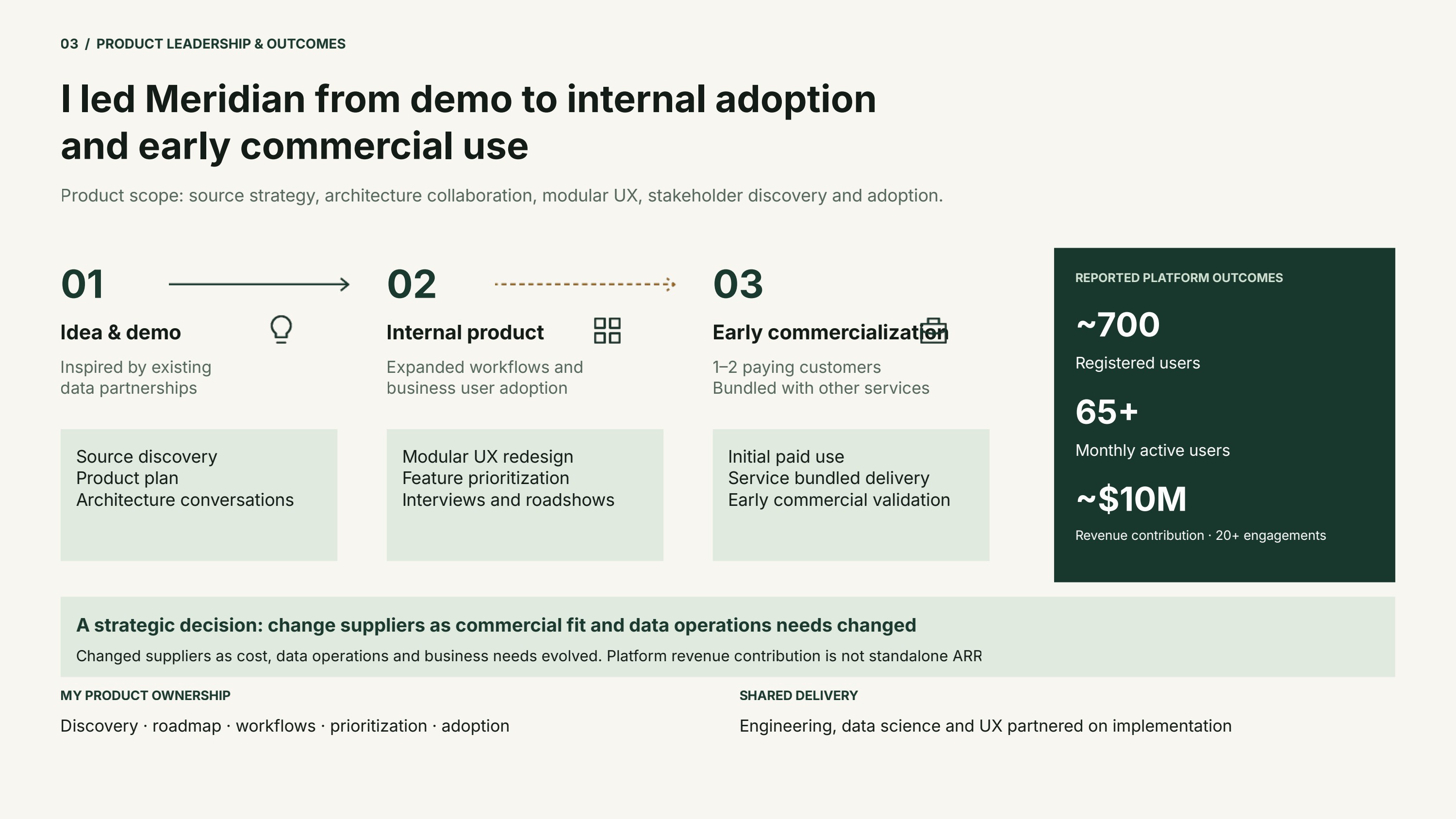
From concept and demo to commercial use.
01
Concept and demo
02
Internal platform
03
Adoption across 5 to 6 teams
04
Early commercial use through client engagements
Approximately 700
Registered users
65+
Monthly active users
20+*
Engagements supported
Approximately $10M*
Associated engagement revenue
The revenue was connected to client engagements using the platform and was not standalone software ARR.
* Engagement count and associated engagement revenue cover the 2024–2025 period.
03 · Product leadership & outcomes
Product judgment
The roadmap changed when the evidence changed.
Simplified cohort workflows after users struggled with excessive steps.
Added ICD guidance and tooltips to reduce definition confusion.
Improved navigation and documentation to increase trust and usability.
Changed data vendors based on cost, quality, reliability, and platform fit.
Kept Text to SQL in POC after inaccurate results and schema hallucinations.
Lessons
What I would carry forward.
Adoption requires workflow simplification, not more features.
Data readiness limits what a product can responsibly promise.
Reusable capabilities create more leverage than isolated custom solutions.